Ravens
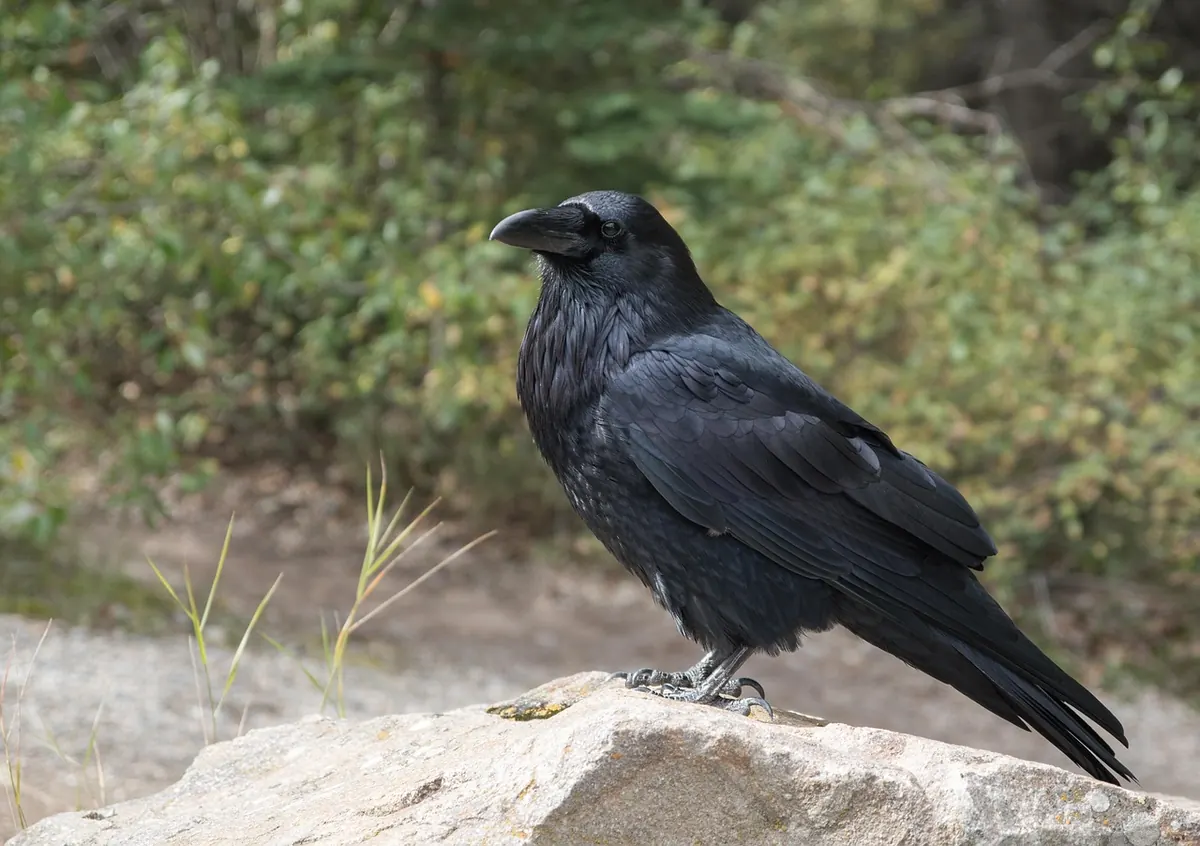
How to Tell a Raven from a Carrion Crow in the UK
Two big black birds, one perched on a fence post and one croaking somewhere overhead. You are almost certain it is a raven, but a small voice says it might just be a crow. It is the most common identification wobble in British birding, and it catches out beginners and experienced birders alike. The good news is that ravens and carrion crows give you plenty to work with once you know what to look for. You do not need perfect views or expensive optics. You need a handful of features, checked in the right order.
Start with size and build
The raven is the largest member of the crow family, noticeably bigger and bulkier than a carrion crow. That sounds straightforward until you are watching a single bird against an empty sky with nothing to compare it to. Size alone is unreliable. Instead, look at the shape and the proportions.
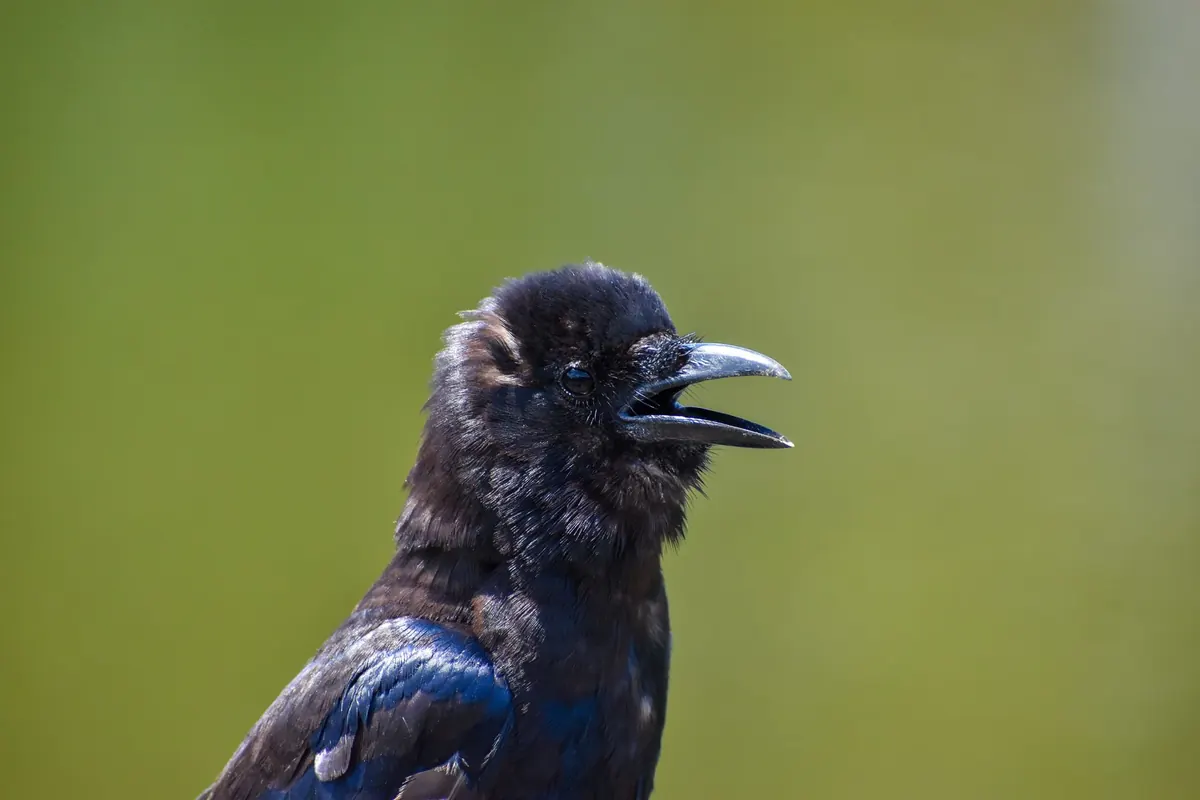
A raven has a heavy, thickset body, a thick neck and a distinctly shaggy throat, with feathers that look loose and untidy under the chin. Carrion crows are sleeker and neater, with a rounder head and a more compact body. The raven's bill is the giveaway: it is huge, deep and slightly curved along the top edge, and it looks oversized even on such a large bird. A crow's bill is modest by comparison, more like a stout dagger than a heavyweight chisel.
If the bird is close enough, check the base of the bill. On an adult raven, the bristles covering the nostrils are long and dense, and the bill looks thick where it meets the face. On a carrion crow, the bill looks slimmer and the face appears smoother.
Read the tail and wings in flight
Flight shape is where identification gets much easier, and it is worth practising whenever you get the chance.
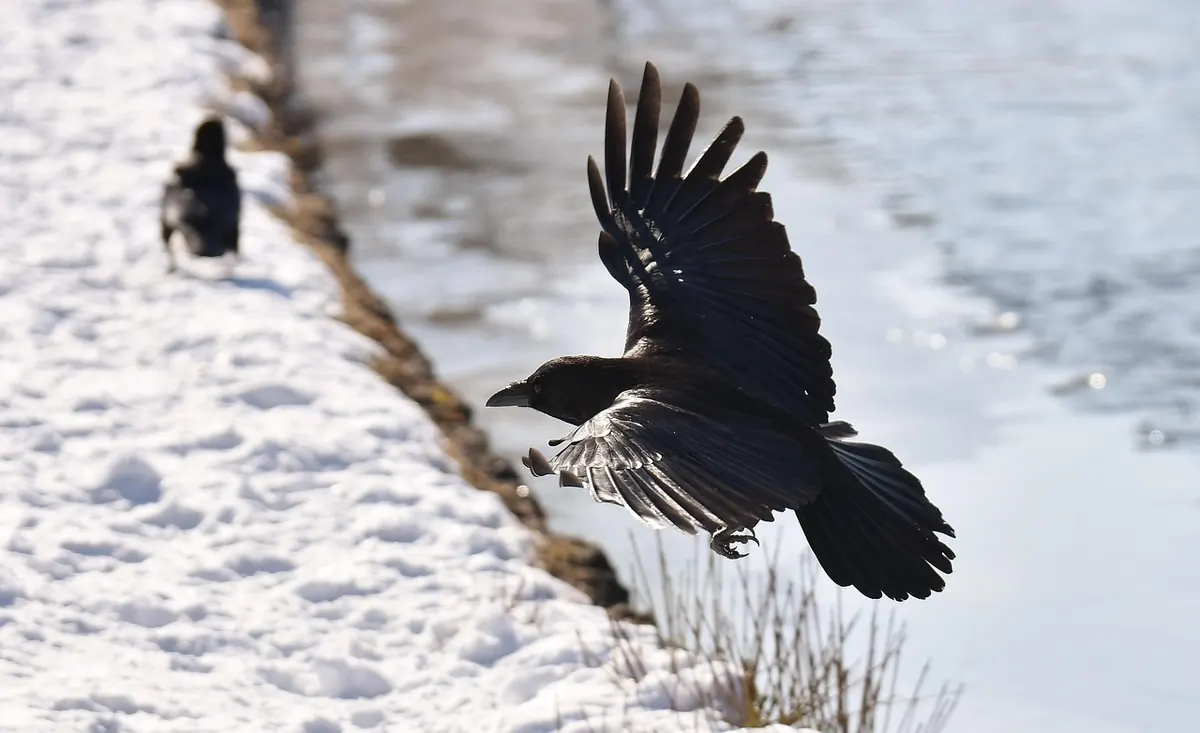
A raven's tail is long and wedge-shaped, and it is most obvious when the bird is gliding or soaring. Seen from below, the central feathers extend beyond the outer ones, so the tail tapers to a point rather than ending in a straight line. Carrion crows have a shorter, squared-off or slightly rounded tail that looks blunt at the end.
The wings tell a similar story. Ravens have long, broad wings with fingered tips, and they often hold them in a shallow V when soaring, with a relaxed, almost lazy bend at the wrist. Carrion crows have shorter, more rounded wings and beat them faster and more evenly, giving a steadier, more laboured impression.
Behaviour matters here too. Ravens glide and soar much more than crows, and they will tumble, roll and dive in display flights, especially in spring. If you see a big black bird half-folding its wings and dropping through the air like a falling leaf, you are almost certainly watching a raven.
Learn the calls
If you only master one skill from this article, make it the call. Voice is often the quickest and most reliable way to separate the two, even when the bird is a distant speck.
The raven's signature call is a deep, resonant kronk or corrk, a hollow, woody sound that carries a long way and seems to come from somewhere deep in the bird's chest. Carrion crows give a harsh, flat caa-caa-caa, sharper and more grating, usually repeated in a steady rhythm.
Ravens also have a surprisingly wide vocabulary. Listen for knocking, bell-like notes, bubbling sounds and soft croaks, often given in pairs or family groups. A pair of ravens calling to each other across a valley is one of the great sounds of upland Britain.
A quick field checklist
Run through these in order. The first two or three should be enough in most sightings.
- Size: raven noticeably bigger and heavier; crow slimmer and more compact.
- Bill: raven very large and thick with shaggy throat feathers; crow smaller and neater.
- Tail in flight: raven long and wedge-shaped; crow short and squared off.
- Wings: raven long, broad and fingered, often held in a shallow V; crow shorter and more rounded.
- Flight style: raven glides and soars, with tumbling displays; crow flaps more steadily.
- Call: raven deep and resonant kronk; crow harsh, flat caa.
- Company: ravens usually in pairs or family groups; crows often alone or in looser gatherings.
Where and when you are most likely to see each
Habitat gives useful context, though it should never be your only clue. Ravens are birds of wild, open country: moorland, sea cliffs, rocky valleys, upland farmland and remote woodland edges. In recent decades they have moved into more lowland areas and even into some towns and cities, so a raven over an urban park is no longer the shock it once was. The Tower of London birds are the famous example, and ravens now breed in several English counties where they were absent for years.
Carrion crows are everywhere. Fields, hedgerows, farmland, parks, gardens, roadside verges, rubbish tips. If you are in a typical lowland setting and the bird looks like a crow, it usually is one. If you are on a Welsh hillside in March and something enormous goes over croaking, reach for the raven column.
A note on other black birds
Rooks are also black and often feed in the same fields as crows, but they have a bare, pale patch at the base of the bill on adults, a peaked crown and a more raucous, communal kaah. Jackdaws are much smaller, with a silvery-grey nape and a neat, quick flight. Neither should cause much confusion once you have seen them a few times.
Getting your eye in
Identification improves fastest with repetition, so treat every sighting as practice. When you find a candidate raven, do not just tick it and move on. Watch it for a full minute if you can. Note the tail shape as it turns, listen for the call, and watch how it uses the air. Those details are what turn a guess into a record you can trust.
Sound is your most powerful tool, so spend time learning the difference between the two calls before you head out. A phone app with British bird recordings will do, and a few minutes of listening on the way to a walk is time well spent. If you are unsure, record the call on your phone and check it later at home.
Finally, be honest about uncertainty. Writing "probable raven" in your notes is far better than claiming a bird you did not properly see. Local bird recorders would much rather have an accurate "possible" than an overconfident "definite". Get out, watch the skies, and let the croak settle it.
Photo: connie_sf / Pixabay