Corvids
A Beginner's Guide to British Corvids: Meet the Eight Species
Corvids get a rough deal. They are loud, scruffy and almost everywhere, which is precisely why most of us stop looking at them. Learn the eight species that breed regularly in Britain, though, and a familiar walk starts to pay attention back: the bird on the fence post becomes a crow rather than just a black thing, and the flock in the far field is suddenly worth a proper stare.
None of the eight is genuinely difficult once you know what to check. Two or three field marks per bird will do it, and after a few weeks you will hear most of them before you see them.
What Makes a Corvid a Corvid
All members of the crow family share a few traits: a sturdy, slightly hooked bill, strong legs built for both perching and striding about on the ground, and a level of cunning that puts most garden birds to shame. They are also long-lived and quick to learn, which is why the same jackdaw will return to the same chimney for years.
Before you go any further, fix two things in your head:
- Size. A raven is roughly twice the bulk of a carrion crow. A jackdaw is noticeably smaller than either, closer to a woodpigeon with attitude.
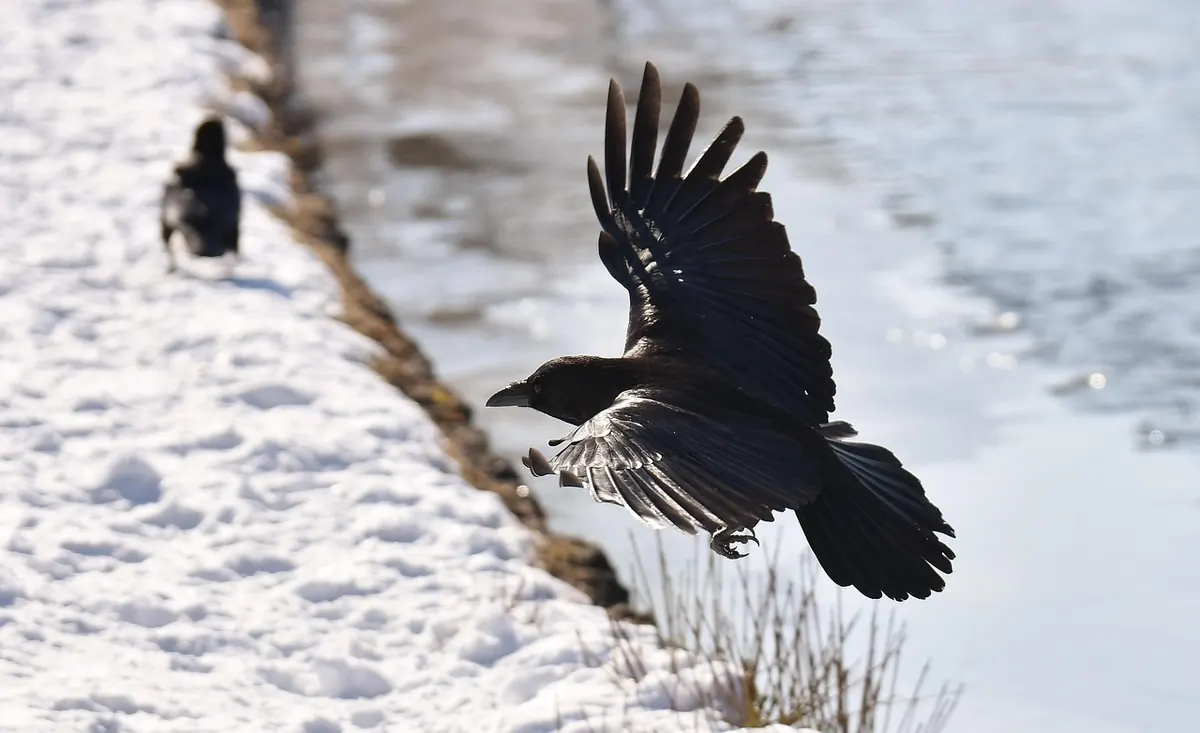
- Tail shape in flight. Crows and rooks show a squared-off tail. A raven's is wedge-shaped, tapering to a point like a diamond.
Sorting the Big Black Birds
Carrion Crow
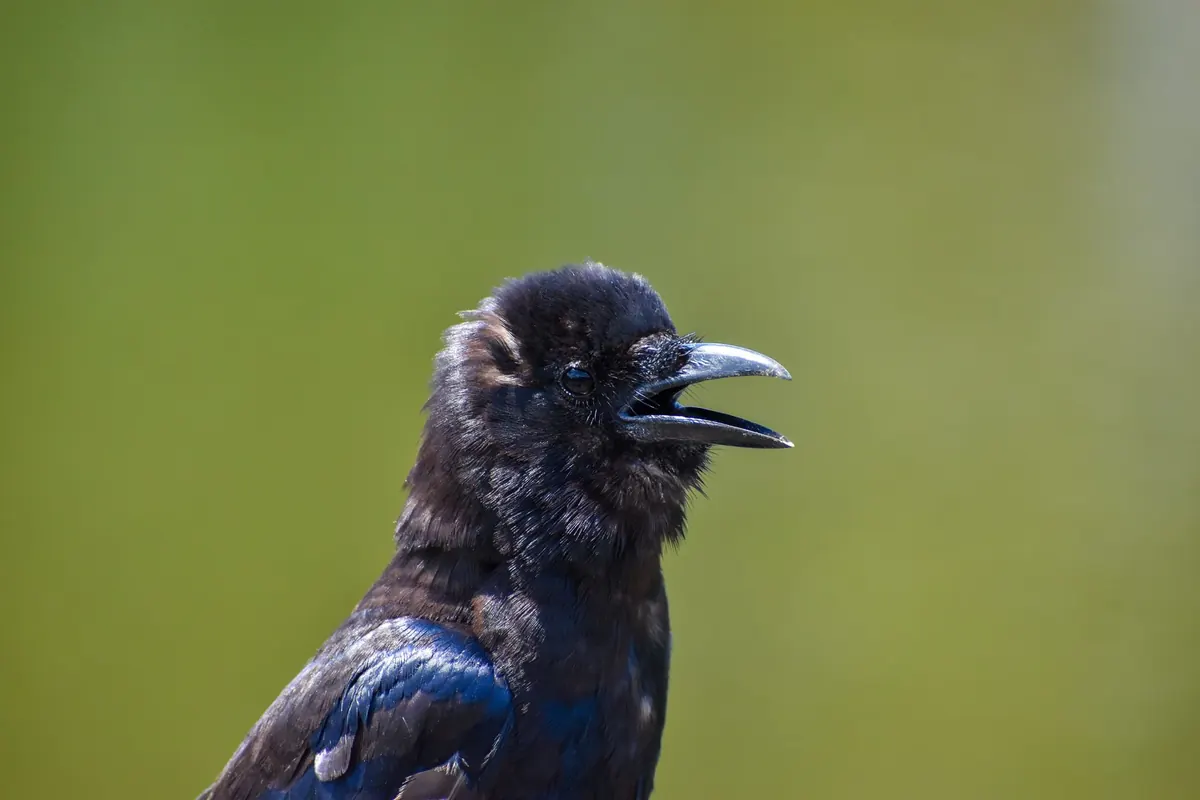
About 45cm, all black with a faint green or purple sheen in good light, a heavy bill and a flat crown. Usually seen alone or in a pair, and it is the bird most likely to be on your lawn, on a roadkill, or seeing off a buzzard. The call is a hard, flat caw, repeated two or three times. Carrion crows are territorial and rarely gather in big flocks outside winter roosts.
Rook
Same sort of length, but slimmer and rangier. Adults have a bare, greyish-white patch at the base of the bill, a peaked crown and loose, shaggy feathering on the thighs. The bill looks narrower and paler than a crow's. The giveaway, though, is behaviour: rooks are sociable, feeding in noisy flocks on stubble and pasture, and nesting in colonial rookeries in tall trees. Their call is a higher, more nasal kaah, and a rookery in early spring is one of the great sounds of the British countryside.
Raven
Big — around 64cm, with a wingspan to match a buzzard's. Look for the massive bill, the shaggy throat feathers, and long, fingered wings in a slow, purposeful glide. Ravens soar and tumble, and the call is a deep, resonant kronk quite unlike anything a crow manages. They are birds of upland Britain, sea cliffs, and increasingly of the south-west and eastern England. In flight, the wedge tail settles it every time.
The Smaller Crowd: Jackdaw, Magpie and Jay
Jackdaw
Small, neat and full of character. Black with a silvery-grey nape and the sides of the neck, a pale eye that gives it a knowing look, and a short stubby bill. Jackdaws nest in holes — chimneys, church towers, old trees, nest boxes — and they pair for life, so a pair drifting about a village roofline in spring is almost certainly local. The call is a bright, chuckling tchak.
Magpie
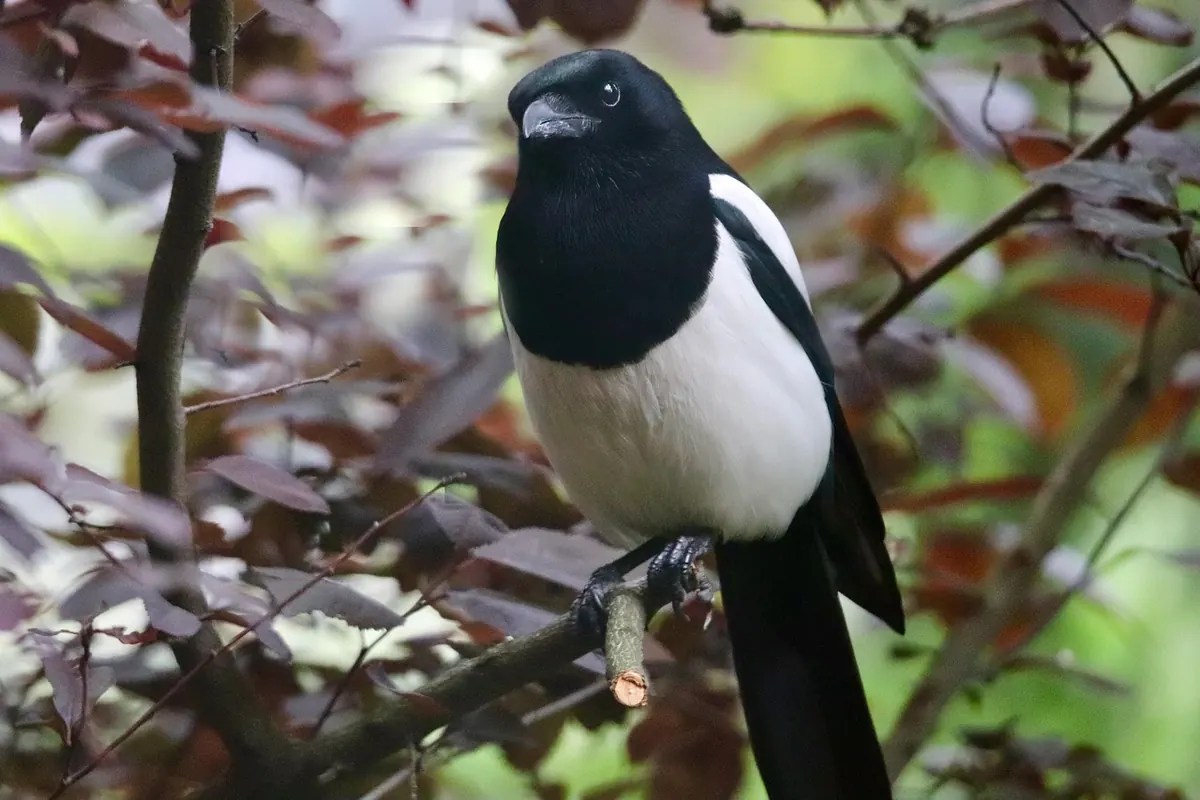
Unmistakable: black and white with a long tail that flashes blue and green in the sun. Bold, curious, and often the first bird to investigate anything new in a garden. The rattle call is a fast, dry chatter, and magpies will mob a cat or a tawny owl with real enthusiasm. They nest in a domed stick nest, usually in a thorny tree or a hedgerow.
Jay
The woodland member of the family, and easily the most beautiful. Pinkish-brown body, white rump, a black moustache stripe and a small barred panel of electric blue on the wing. Jays are shy in open country but can be surprisingly tame near houses. Listen for the harsh, tearing screech — it usually announces a jay before you spot it. Autumn is their season: they carry and bury acorns, sometimes several kilometres from the parent oak.
Two Specialists: Hooded Crow and Chough
Hooded Crow
Think of a carrion crow wearing a grey waistcoat. The body is ash-grey, the head, throat, wings and tail are black. In Britain it replaces the carrion crow across much of Scotland, especially the Highlands and islands, and is found in Northern Ireland, too. In the narrow band where the two meet, they interbreed and produce confusing intermediates — so in central Scotland, take your time over odd-looking crows rather than assuming.
Chough
The rarest of the eight and the only one with a red bill and red legs. Glossy black plumage, a greenish sheen in sunlight, and ragged, fingered wingtips. Choughs nest in caves and crevices on sea cliffs and feed on short, grazed coastal turf, turning over dung and probing the soil for invertebrates. The call is an unmistakable whistled chee-ow. Look for them in north and west Wales, the Isle of Man, the Scottish islands, and on the Cornish coast.
Where to Look
You do not need to travel far for most of these. Try these settings:
- Farmland, road verges and playing fields: carrion crow, rook, jackdaw, magpie. Watch for mixed feeding flocks, which are often rooks and jackdaws together with a crow or two on the edge.
- Village edges and parkland in February and March: rookeries at their noisiest, jackdaws prospecting for holes.
- Woodland and mature gardens, September to November: jays on the move, caching acorns.
- Uplands, moorland and sea cliffs: raven, often in display flight on a windy day.
- Western Scotland, the Hebrides, Northern Ireland: hooded crow.
- Grazed coastal cliffs and headlands: chough — patience and a quiet approach are essential.
Watching Them Well
Start by learning three calls: the crow's flat caw, the rook's higher kaah, and the raven's deep kronk. That alone will settle most of the black birds you meet, even before they come into view. Then watch how each bird leaves the ground — crows and rooks flap steadily, ravens glide, jackdaws bounce along with quick, flicking wingbeats.
Winter dusk is worth planning around. Rooks and jackdaws form large communal roosts, sometimes numbering in the thousands, and watching a stream of birds funnel into one wood is one of the easiest spectacles in British birding. Keep a notebook of what you see and where; patterns emerge faster than you would expect.
Finally, a word on conduct. All wild birds in Britain, corvids included, are protected by law, and it is an offence to disturb an active nest or take eggs. Photograph from a distance, keep dogs away from cliff-edge nest sites, and leave fallen young birds alone unless they are clearly in danger — the parents are usually nearby and watching you.
Photo: Nennieinszweidrei / Pixabay