Corvids
Magpie vs Jackdaw: How to Tell These Two Corvids Apart
Two of the most familiar corvids in Britain are also two of the most frequently mixed up. A magpie on a lawn is unmistakable, but a jackdaw in poor light, or a young magpie with less white on show, can leave even an experienced birder second-guessing. The good news is that these birds differ in almost everything a field observer cares about: shape, colour, voice, behaviour and where they choose to spend their time. Learn four or five key features and you will separate them at a glance.
Start with size and silhouette
Silhouette is the fastest route to an identification. Magpies are big for a corvid, roughly 44–48 cm from bill to tail tip, and a good deal of that is tail. They look front-heavy: broad, rounded wings, a sturdy body, and a long, graduated tail that trails behind and flicks up and down in flight. On the ground, a magpie moves with a confident, almost swaggering walk, tail held clear of the grass.
Jackdaws are much smaller, closer to a pigeon in bulk, around 34 cm, and compact. Their tails are short and square-ended, their wings are narrower, and their flight is quicker, with more frequent wingbeats. Where a magpie can look like a bird towing a black ribbon, a jackdaw looks like a small, tidy crow. If the bird is in a tight, fast-moving flock over fields, it is almost certainly a jackdaw; magpies are rarely so sociable.
Plumage: black and white versus sooty grey
Magpies are pied, and there is no real substitute for that word. The head, breast, back and tail are glossy black, but the belly, flanks and shoulders are white, forming two bold panels on the folded wing. In good light, the tail and wing coverts show metallic greens, blues and purples, an iridescence that shifts as the bird turns. Adult males and females look alike.
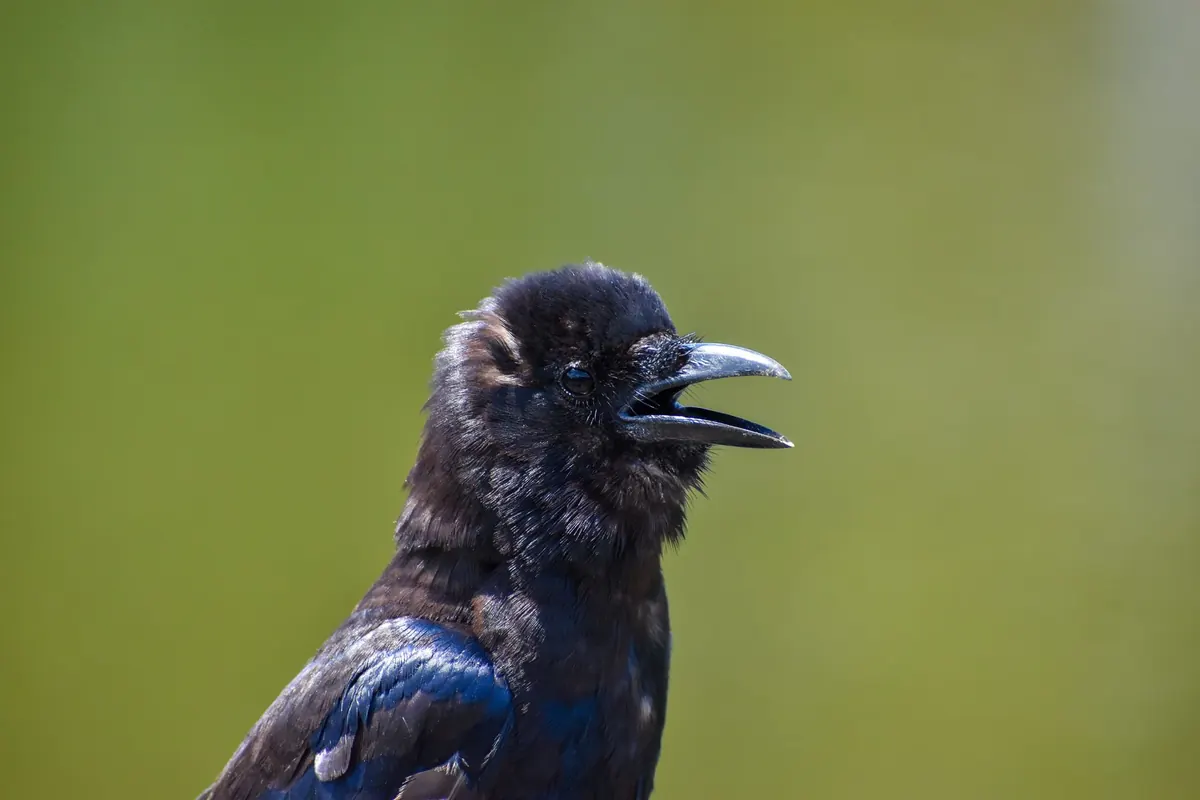
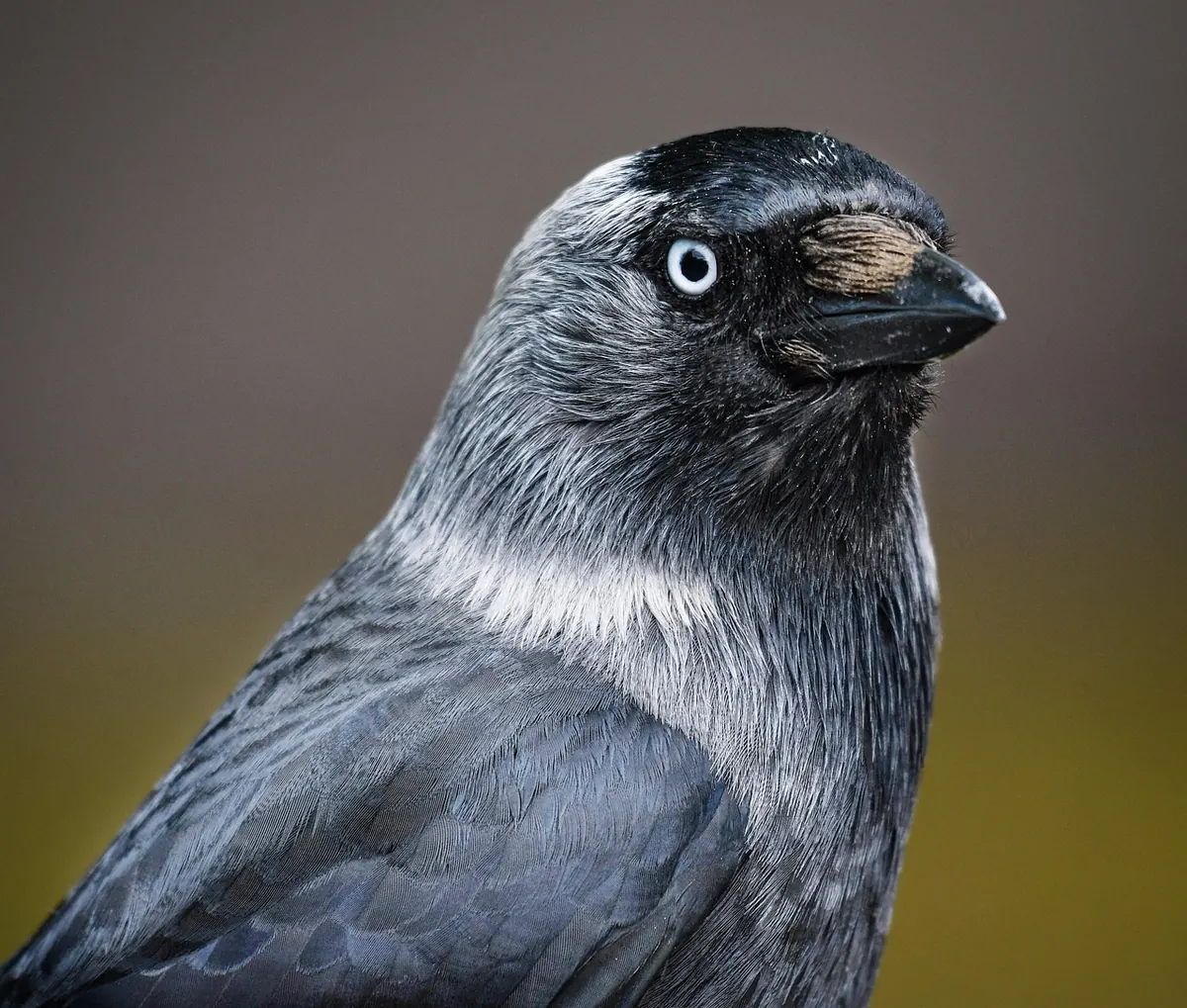
Adult jackdaws are dark, but not simply black. They have a sooty, charcoal-black body and a silvery-grey nape and sides to the head, sometimes called a shawl, which contrasts with a darker crown and face. The bill is short and stubby, quite unlike the magpie’s heavier, wedge-shaped bill.
The eye test
The eye is the detail that converts a suspicion into an identification. Adult jackdaws have a pale, icy blue-grey eye, while magpies have a dark eye. Juveniles are trickier. Young jackdaws have dark eyes and duller, browner plumage, and young magpies have shorter tails and less crisp white, which is why autumn birds cause so many queries.
Calls: the quickest give-away
Voice is often conclusive, even before the bird is properly in view. A magpie’s alarm is a harsh, dry rattle: chak-chak-chak-chak, usually accelerating, sometimes accompanied by a whining or mewing note. It is a sound that carries across a garden and often continues for some time.
Jackdaws make a short, clipped, metallic jack or chyak—one clean syllable, repeated. A lone bird may call two or three times as it flies over; a roost or feeding flock turns that into a busy, conversational clatter. The pitch is higher than a magpie’s rattle, and the rhythm is more staccato. If you hear a single sharp jack and look up to see a small, dark bird with a pale eye and a grey hood, you have your answer.
A useful mnemonic: magpies chatter, jackdaws jack.
Behaviour: bold opportunist versus social acrobat
Magpies are intelligent, curious and bold. They often work in pairs or small family parties, and they are quick to investigate anything new—a bin bag, a hedge being trimmed, a cat in the flowerbed. They cache food, eat a wide range of insects, seeds, carrion and scraps, and they are well known as nest predators, though they are far from the only ones. Their nest is a large, domed structure of sticks with a side entrance, usually built in a tall tree or a dense bush. When a magpie is annoyed, it will often sit high and scold, tail flicking.
Jackdaws are the more sociable of the two. They gather in flocks, sometimes mixing with rooks, and they roost communally in trees, on buildings or in chimneys. Their flight is agile and playful; in spring, pairs perform tumbling, diving displays. They nest in holes and cavities—tree holes, church towers, chimneys, ruins, nest boxes—rather than building a domed nest of their own. A jackdaw perched on a chimney pot, peering down as if inspecting the flue, is a classic sight.
Habitat: where each is most likely
Both birds are adaptable, and both occur in towns and farmland, so habitat alone will not settle every identification. Even so, the odds differ.
- Magpies: hedgerows, field edges, parks, gardens, allotments, roadside verges and the edges of woodland. They are often seen on lawns and playing fields, picking through grass, or on low bushes and fence posts.
- Jackdaws: cliffs, quarries, ruins, church towers, mature trees with holes, farmland with old hedgerow trees, and urban areas with old buildings and chimneys. They feed in open fields and on short grass, often in flocks, and they are regulars at rubbish tips and livestock fields.
If you are in a suburban garden and a black-and-white bird with a long tail lands on the lawn, that is a magpie. If a small, grey-hooded bird with a pale eye drops onto a chimney or joins a noisy flock on a stubble field, that is a jackdaw.
A quick field checklist
Use this sequence when a dark corvid flies over and you cannot decide.
- Check the tail. Long, trailing and graduated: magpie. Short and square: jackdaw.
- Look for white. Bold white belly, flanks or wing panels: magpie. None: jackdaw.
- Check the eye. Dark eye: magpie. Pale, icy eye: adult jackdaw.
- Listen. Harsh accelerating rattle: magpie. Short, sharp jack: jackdaw.
- Watch the company. Alone or in a pair: more likely magpie. Tight flock, especially with rooks: jackdaw.
- Note the perch. Domed stick nest or scolding from a treetop: magpie. Chimney, hole or church tower: jackdaw.
Practise on your patch
The best way to lock in these differences is to spend ten minutes watching the next corvid you meet, rather than ticking it and moving on. Note the tail length, whether the bird shows white, and the exact sound it makes. If you have a phone, record the call and listen back; the difference between a magpie’s rattle and a jackdaw’s clipped note becomes obvious with repetition.
Visit a local churchyard or park with mature trees in late winter, when both species are vocal and active, and you will often see them side by side. Once you have separated them a few times, the identification becomes automatic—and you will start noticing which one is really doing the scolding outside your window.
Photo: Anders_Mejlvang / Pixabay